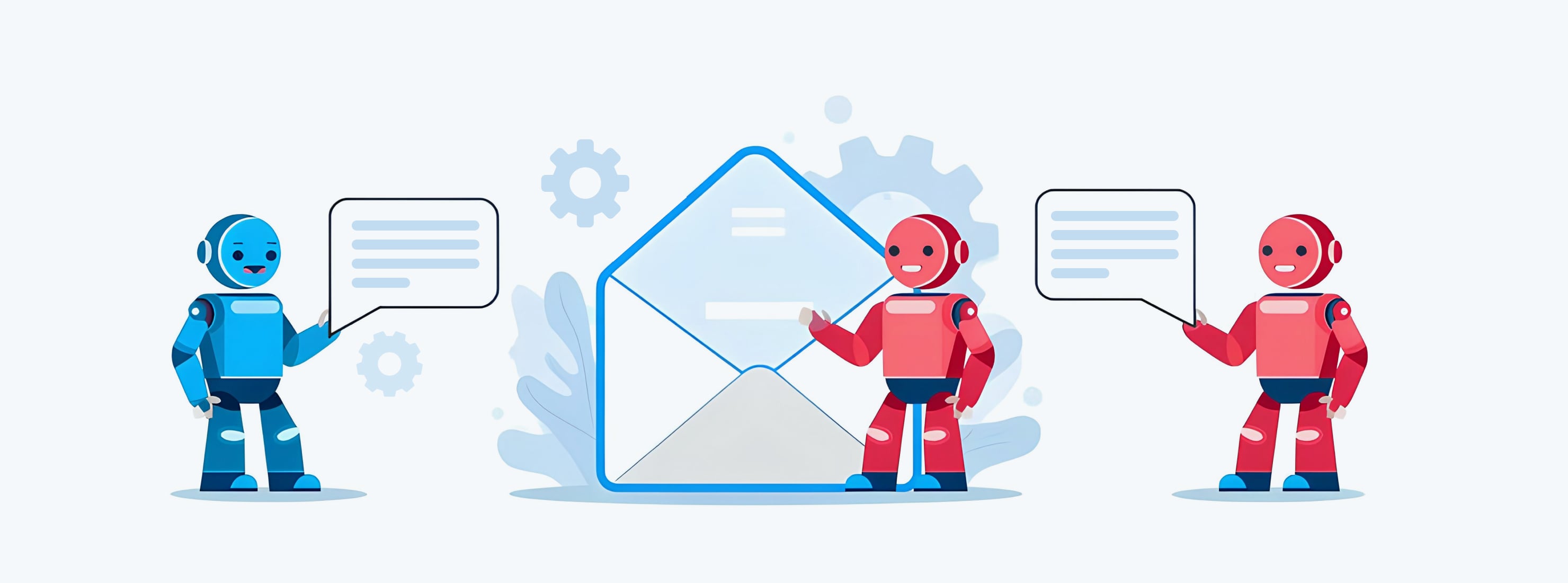
If I see one more marketing email that begins with "In today’s fast-paced digital landscape, unraveling the tapestry of customer engagement…" I’m going to personally revoke internet privileges of whoever wrote the prompt.
We’ve officially passed the honeymoon phase with generating email copy via machine learning. We’re no longer impressed that a computer can write a 300-word promotional broadcast in four seconds. We’re annoyed that half of them sound like a robotic Victorian butler trying to sell B2B enterprise software. In the speed and ease of use of today’s AI tools, we also want authenticity and originality. Those can be hard lines to blur.
Here at Raka, we spend a significant amount of our days obsessing over open rates, CTRs, and conversion benchmarks. Over the past year (and change), we’ve put the major LLMs and copywriting platforms through a gauntlet of real-world testing, from re-engagement sequences to direct-to-consumer product and service launches (and everything in between, to be perfectly honest…)
So, stripped of vendor hype, which tool actually drafts a better AI marketing email? We’ll give you our unbiased thoughts in a couple of key areas in the following paragraphs.
Let’s step into the ring.
Table of contents
The contenders
Before we start judging prose, it’s worth clarifying who’s actually fighting in this arena. The software market generally splits into three main camps:
- The Pure Foundation Models (The Brains): Direct access to models like Claude (Anthropic) and ChatGPT (OpenAI). No guardrails or pre-built templates; just raw reasoning power.
- The Integrated Ecosystem AI (The Native Operators): Native features like HubSpot’s Breeze AI, built directly into Marketing Hub. They leverage your existing CRM data, contact lists, and past performance metrics natively without needing external API connections. This is a beautiful all-encompassing solution if you’re at the proper subscription level (professional or enterprise).
- The Marketing Wrappers (The Workhorses): Dedicated platforms like Jasper and Copy.ai. Under the hood, these run on API connections to foundation models, but they wrap them in specialized user interfaces, pre-built prompt frameworks, and brand voice repositories.
Okay, sound the bell!
Round 1: Subject lines and hooks
The task: Drive urgency without landing straight in your contact’s spam folder or resorting to cheap clickbait like "Fwd: Quick question..."
| AI Tool | Key Findings |
|---|---|
| ChatGPT | OpenAI’s models are the undisputed kings of punchy, high-energy brainwriting. If you ask ChatGPT for 15 subject line variations for your AI marketing email campaign, 10 will be mediocre, three will be usable, and two will be genuinely brilliant hooks that your human copywriter will wish they thought of first (and, heck, maybe they did…). |
| Claude | Claude tends to play it a bit safer. Its subject lines are logical, clear, and well-structured, but they can occasionally lack that slight edge of unpredictable creative spark. |
| Jasper | Jasper shines here due to its marketing-focused template library. Selecting a pre-built app like "Catchy Subject Lines" or running a PAS (Problem-Agitate-Solve) framework gets you 80% of the way there without having to construct a 50-word custom prompt from scratch. That equates to some true time-savings. |
| HubSpot Breeze AI | This is where native platform features shine for sheer speed. Generating subject line variants directly inside the Marketing Hub email editor saves you from tab-switching and engineering a 50-word prompt every time you want to send an AI marketing email. Plus, testing those subject lines against your actual list segments happens seamlessly in the same view. |
Round winner: ChatGPT
Its knack for persuasive hooks and creative angles gives it the edge for getting opened. It’s also easy to chat with. It’s a robotic friend that isn’t afraid to continue iterating if that’s what the conversation lends itself to. At some point, your real-life colleague will straight up look you in the eye and say, “Listen, we need to move on… Just A/B test it, will you?”

Round 2: Body copy and brand voice nuance
The task: Draft a three-part nurture sequence that feels conversational, empathetic, and uniquely tailored to a specific brand identity without sounding like an ad.
| AI Tool | Key Findings |
|---|---|
| ChatGPT | If left unsupervised, ChatGPT will hit every cliché in the book. It loves words like "game-changer," "elevate," "seamless," and "empower." You can prompt it out of these habits, but it takes constant nudging to keep your AI marketing email copy from sounding like a generic keynote speaker. If you’re not editing the outputs, you’re setting yourself up for some serious adverse triggers. |
| Claude | This is where Claude embarrasses the competition. Claude has a far better natural grasp of human cadence, subtle tone, and sentence-structure variation. It handles complex brand guidelines smoothly and produces body copy that requires about 60% fewer edits to sound genuinely "human." (The 60% stat is largely a “guesstimate” based on our own testing practices here at Raka. It could range either way depending on the user/prompt.) |
| Jasper | When trained on a solid Brand Voice repository, Jasper generates clean, reliable copy that adheres well to style rules. However, because it relies heavily on structured marketing frameworks, drafting a multi-part AI marketing email sequence inside the platform can start to feel a bit formulaic if you don't manually break up the rhythm. Pay attention to the way it intros every email. If you’re not careful, you’ll wind up sending a three-part sequence that all starts with “In a time when…” |
| HubSpot Breeze AI | Native CRM AI tools have gotten remarkably good at matching existing content voice by analyzing prior campaign performance in your portal. While the raw prose still leans slightly structured, having your brand voice presets mapped directly to your workflow templates makes scaling mid-funnel nurture copy remarkably efficient. |
Round winner: Claude
Hands down. If you want copy that reads like an actual marketing strategist wrote it on a Tuesday morning (don’t ask why we’re calling out Tuesday specifically, just play along…), Claude is the closest you’ll get.
Round 3: Workflow, scalability, and agency efficiency
The task: Manage copy production across dozens of client portals with varying brand styles, complex smart content rules, approval workflows, and multi-channel campaign needs.
| AI Tool | Key Findings |
|---|---|
| Raw LLMs (Claude & ChatGPT) | Key Findingst context across dozens of client accounts gets messy fast in a standard chat interface. |
| HubSpot Marketing Hub | For an agency managing complex growth strategies, native integrations win every time. Drafting, testing, personalizing with CRM tokens, and scheduling an AI marketing email directly within HubSpot eliminates the copy-paste fatigue that plagues high-volume teams. |
| Jasper / Copy.ai | Dedicated wrappers offer great centralized style guides, but unless they are deeply integrated into your tech stack, they still add an extra layer between copy generation and campaign deployment. |
Round Winner: HubSpot native workflows
The speed of going from draft to live A/B test inside your primary marketing platform simply can't be beaten at scale.
The verdict: Who actually wins?
If forced to pick an absolute winner, the answer comes down to what you value most:
-
For pure copy quality: Claude takes the title belt. It crafts an AI marketing email with a level of restraint, flow, and brand-voice accuracy that makes human copywriters less afraid for their jobs and more excited about their workflows.
-
For creative ideation and hook generation: ChatGPT remains the go-to brainstorming partner.
-
For seamless execution and scaled systems speed: HubSpot’s embedded AI features win on ecosystem efficiency. Generating and testing copy right inside your CRM beats bouncing between five browser tabs any day.
The uncomfortable truth
Here’s the plot twist no software vendor wants to put on a landing page: No tool writes a great AI marketing email right out of the box. Not even Claude, whom we’ve crowned the victor in this respective category above.
Software doesn't understand your customer's deepest anxieties; it doesn't know why your last campaign flopped, and it certainly doesn't possess a natural sense of humor (unless you consider puns about "bot-tastic savings" peak comedy). I don’t.
The most effective campaigns aren't generated purely by machines or written entirely by humans in isolation. They come from strategists using tools like Claude, ChatGPT, or Breeze AI as a first-draft engine, followed by a human editor who knows how to inject soul, subtext, and genuine strategy.
One of the hardest things to do as a writer is simply starting to add words to a blank page. You know… Writing. Seems counterintuitive, but there’s some truth to that sentiment.
Being able to use technology for speed of adoption (getting a foundation started on the page), leverage your CRM data for relevance, and keep a human hand firmly on the steering wheel is the true victor in this battle. So consider it and do with this intel what you will. Your unsubscribe rate will certainly thank you.